Odin, Wikipedia and Engagement Farming
Imagine one day you wake up, you drink your morning glass of milk, brush your teeth, sit on your computer, stare your own diffuse image on the display, while reflecting on your own gingerness. You turn on the nerd machine while doing the daily "no updates" Windows pray. The computer is finally on, and what is that... Wikipedia link? What is this "Articles for Deletion Odin (Programming Language)", oh no, that doesn't sound good.
Fortunately we are mere readers of these events. I don't know if that's an accurate reconstruction of GingerBill's steps (creator of the Odin Programming language, and officially recognized ginger) as I'm not him nor Palantir, but I'm fairly confident about the ginger part, and that at some point he read the following statement about the article on the Odin Programming Language:
Non-notable programming language that has received no in-depth coverage from reliable sources. The article's current sources consist of the developer's personal sites, random blogs that happen to use the language, and a self-published e-book. Coverage in academic research consists of trivial mentions.
Last week, the Odin article on Wikipedia was deleted through a typical Articles for Deletion (AfD) process:
| Action | User | Time (UTC) |
|---|---|---|
| Delete (started AfD) | Helpful Raccoon | 23 Mar 20:53 |
| Delete | Stepwise Continuous Dysfunction | 23 Mar 21:05 |
| Delete | GearsDatapacks | 23 Mar 21:11 |
| Keep | ~2026-18350-69 | 23 Mar 23:00 |
| Keep | ~2026-84628-5 | 23 Mar 23:57 |
| Delete | Stationsation | 24 Mar 00:58 |
| Comment | Oaktree | 24 Mar 13:25 |
| Delete | Oaktree | 25 Mar 13:11 |
| Keep | Alec Gargett | 26 Mar 09:17 |
| Keep | ~2026-84628-5 | 28 Mar 00:06 |
| Delete | ~2026-19267-04 | 28 Mar 03:38 |
| Delete | ~2026-20021-65 | 31 Mar 01:03 |
Summarizing it, 5/7 for delete have accounts, and 1/4 for keep have accounts. Not along after the final vote, a Wikipedia admin deleted the article. Being a little bit lax with my language, the majority's consensus agreed that Odin isn't notable, and the article had no reliable sources.
If you are familiar with Odin, one of the most popular "C competitor" languages, this might sound a little bit insane to say out loud. How can Odin not be notable? If you are terminally online on programming circles, you most likely have heard of Odin, it's so obvious that I don't feel like I have to make a case at all. It has been covered by the streamer Primeagen and it's used commercially by JangaFX, that's pretty notable to me.
I will be one of the first to say that Wikipedia's processes are far from perfect, and that comes from a place of someone who loves Wikipedia. I love information building, organizing and categorizing, it's a whole challenge in itself. While I would love to talk about indices, references and all of that, for the sake of narrative sense I want us to go back to on our main victim here: GingerBill. How did he feel about this?
Luckily for us GingerBill has made some version of his thoughts public. It starts with him thanking a YouTuber called BrodieRobertson for his video Bizarre World Of Wikipedia Deleting Programming Pages, which covers specifically the Odin deletion.
I will show GingerBill's posts as-is except for minor highlights. Ideally I would like if you as a reader were to read as much context as you can before reading my interpretation, but for brevity purposes this first sequence is the only sequence I'm presenting without intertwining my commentary, so if you wish to do so, I recommend trailing away GingerBill's twitter thread.
Not because this will make it easier my point to be made, but because the entire point of this article is to counter the social media persona where dunking by performative disinterest and uncuriosity are a virtue and rewarded by engagement and short-term reward structures. Nonetheless, the thread:

Thank you @BrodieOnLinux for covering the Wikipedia fiasco for Odin.
We don't particularly care if Odin is on Wikipedia or not; especially
when
The Wikipedia Mods (like Reddit mods, or even Digg mods back in the day), view themselves as "journalists" and trying to do the "morally ideological" thing by only allowing certain posts on there; programming languages are just one example of that.
For many people programming languages are a religion to them, rather than just a mere tool. They will try and defend their favourite language at any cost, even if that means not allowing other languages to "advertise".
The entire
I started Odin nearly 10 years ago now, and it was never meant to be as big as it was today. Wonderfully, Odin is now being used by dozens of companies, thousands of public projects, and over a million hobbyists.
We are really grateful for everyone who enjoys and uses Odin, and we will continue to improve it.
The comments saying that anyone can make a language is true, but those are usually mere toys,
and cannot be used for anything useful.
Many people think Odin is "just for games" at the moment, but that tells you more about the people who say that than Odin itself. This is especially true when gamedev is pretty much the most wide domain possible where you will do virtually every area of programming possible.
Odin is a general purpose language; is capable of being used in numerous different areas from application development, servers, graphics, games, kernels, CLI/TUIs, etc.
We believe in the coming months with the introduction of things like the native http package and a few other things, that those packages alone will make people think Odin is a "proper language".
We hope that because of all the tremendous effort that everyone who has put work into the language that: Odin will be an overnight success—a decade in the making.
This first thread clearly has two topics in its throught stream: Wikipedia is unreliable, gatekept by activists, ideological playground where rules are mere procedural tools to achieve their ideological goals — and Odin will persevere.
I like how GingerBill has highlighted that Wikipedia mods state everything in public since that enables us to find two of my favorite things: paper trail and evidence.
If you paid careful attention, I've mostly highlighted statements directed at Wikipedia. Most non-highlights sound like a rallying cry for the Odin community, I take no issue with that, virtue signaling is part of forming a community.
On the other hand, the highlights are serious accusations about a culturally significant institution, and these statements are rhetorically contradicted by the discourse's evolution in the following day. The tone shifted when a minor twitterino (260 followers) tagged big twitterino Jimmy Wales (Wikipedia co-founder, 214.5k followers) 1 — thus he replied about the alleged persecution to delete Odin's article:

Thank you.
I say this as someone who leans somewhat "inclusionist" - it seems like a good deletion to me.
Well I guess that's it, Jimmy has spoken and he agrees with the AfD's consensus and the admin's deletion. Surely that's end of story? Says the writer halfway through an article with a confronting title.
That was not it, on the contrary, a new foe has appeared and I'm about to make a lot of enemies.
Casey Muratori, performance-aware warrior, star programmer, slayer of oops, mother of dragons, has appeared. Short introduction, he is a famous videogame programmer who used to work at RAD Game Tools, but has made a significant following due his Handmade Hero livestream series where he codes a game from scratch.
The series is great and I recommend watching some episodes if you have a lot of spare time, his educational content is — in my personal observation — very positively influential. Not necessarily due direct influence, but because his streams facilitated an online and physical community around carefully crafted software. [2]
Let me be clear from the get go about a couple of things — doing good doesn't negate the bad, being good at A doesn't mean good at B2 — sounds obvious when spoken out-loud but we forget that in conversations all the time. So I truly mean my compliments, as much as I mean the criticisms that follow.
We will see now another tweet thread, but this one will have some of my notes on it. If you want to see it through a more unfiltered lens, click on the first tweet's date.
Nonetheless, this tweet got two interesting replies, one from Casey and one from GingerBill, both are shown for chronological reasons, GingerBill's tone has shifted from dismissive and disinterested on Wikipedia and its activists, to some concern about its processes for programming languages in general. For now, we focus on Casey because he is more consistent:
Thank you.
I say this as someone who leans somewhat "inclusionist" - it seems like a good deletion to me.

I created the programming language of the article that was deleted.
(...) about establishment media
"Reliable sources" in programming are scarce. The examples cited in the comments of that deletion discussion are either sparsely read or not even general-programming-related. The field simply lacks well-respected journals or forums for serious discussion: it's the Wild Wild West. Peer-reviewed papers on programming topics specifically are not necessarily reputable or reliable (unlike peer review in other fields, which operates quite differently). Most of the old "reputable sources" are exactly that: old. Few people read them anymore, and many have devolved into product advertising or chasing the latest hype-cycle. Who decides which websites are more authoritative than others, especially when no one is regularly reading them?
Applied consistently, these criteria would warrant removing over 90% of programming-related articles from Wikipedia. I don't want that, but it would be the logical outcome.
This isn't a plea to reinstate the article. It's a request to reconsider how these rules apply to the programming domain.
That does sound relevant, do you have a source which shows that this company has their codebase written in Odin?5
Decisions like this aren't permanent and can be reviewed. Spending too much time on twitter makes people angry and defensive but it's better to just engage with people in good faith.
Sources are what will persuade me (and others).6
The question is not whether there are sources, the question is whether Wikipedia's policy allows acknowledging them.
In the modern world, the best sources on whether JangaFX's software is written in Odin are the people who wrote it. They say that it is. Their website literally has a link on the home page menu that says "Odin programming language - our language of choice". If that is unpersuasive, a JangaFX founder replied to this very thread to tell you that their codebase is written in Odin :)
But as far as I can tell from having seen this sort of thing play out multiple times,
in Wikipedia's world,
That approach leads to situations like this,
(...)
Meanwhile, go lookup any programming language from 50+ years ago - even those that were purely theoretical, and with which literally no one ever shipped a single piece of software - and I guarantee you there is a Wikipedia entry. It probably even has examples of the syntax of the language included in the page.
Plankalkül? Yep. Böhm's Language? No problem.
Again, the reason for this is obvious: before the widespread use of the internet, you had to formally publish something if you wanted to talk about a programming language. So no matter how obscure, there will always be a few printed sources discussing the language. By Wikipedia's rules, that makes it easy to find "sources" to defend a language's "notability".
That's simple not how the programming world works today.
Look, I disagree with most arguments and framing made by Casey, but what he is getting at is something I roughly agree with. The general notability guideline (WP:GNG) is unfair to most programming knowledge, which mostly lives in an informal layer that isn't backed by traditional institutions with incentive structures and accountability that encourage reliability.
A modest step could be to add subject-specific guidelines (WP:SNG) for programming. Specifically about Odin's case, an approach could be a list of notable source code servers, which may make it into the list through traditional notability guidelines or by some metric (Daily users? Repository count?), and the number of repositories on that programming language may make it "notable".
The notability by itself nor JangaFX's website would be enough by themselves to have an article, but together it should be enough for that case.
##Oh my, Wikipedia
Let's take a break from Casey and GingerBill for a moment, please sit down, if you are already sitting down, sit down harder. We are about to talk about the real fun stuff: policies and procedures.
Okay, let me make this a little bit more... enticing. If you are reading this you are likely a programmer, do you remember the first time you wrote any code? The moment you realized you can see and interact with the innerworking, remember how you felt empowered, curious, and wanted to try and learn as many things as possible? Wikipedia's guidelines are a little bit like that.
There are guidelines and definitions for everything:
- Notability? Got it.
- Reliable sources? Whole list of discussions and consensus.
- What Wikipedia is not? Way ahead of you.
Wikipedia is highly procedural, transparent and distributed. This means that if you are making an argument, it will be stronger if you back it up by linking previous consensus and guidelines.
Let me highlight a few statements, first Notability:
Information on Wikipedia must be verifiable; if no reliable, independent sources can be found on a topic, then it should not have a separate article. Wikipedia's concept of notability applies this basic standard to avoid indiscriminate inclusion of topics. Article and list topics must be notable, or "worthy of notice". Determining notability does not necessarily depend on things such as fame, importance, or popularity—although those may enhance the acceptability of a topic that meets the guidelines explained below.
A core pre-requisite is verifiability backed by reliable and independent sources. A youtube link largely falls on the failing side of these, archiving a video is expensive — therefore the link's verifiability is at the mercy of the video creator and the platform. Youtube may change its policies at any moment, and influencers are a nest of COI. Generally Wikipedia discourage user generated content, but it doesn't mean that they can never be used as sources, this will depend on the load they bear, for sure not enough to sustain an entire article.
On verifiability, Wikipedia goes to extra lengths to have everything traceable[3], it archives outbound links even to articles from traditional news organizations in its reliable source list.
The problem with allowing usergenerated content is volume, complexity and accountability. Anyone can create a tweet and claim anything, tweets can be deleted, edited, people can be impersonated, and the consequences of abusing these are minimal, the barrier of entry can't be any lower than that. Documenting these is a problem in itself, and it's hard to do in a meaningful capacity without editorilizing.
This is why Wikipedia chooses to restructure it as a simpler problem, its guidelines discourage that Wikipedia even act as a secondary source, it should be a tertiary source. It's role is to collect and index information that has already been processed by mostly independent actors.
If you go through WP:LISTOFSOURCES you can find every discussion (noticeboard) for every source, such as: Amazon, YouTube, Fox News, MSNBC, Al Jazeera English, Al Jazeera Arabic, Twitter. For example, Fox News is deemed unreliable for political news, and Al Jazeera Arabic as biased on the Arab-Israeli conflict, a topic where the Qatari government has a major conflict of interest. Here is the summary for Fox News (talk shows):
Fox News talk shows, including Hannity, Tucker Carlson Tonight, The Ingraham Angle, and Fox & Friends, should not be used for statements of fact but can sometimes be used for attributed opinions.
Before I conclude this glimpse into Wikipedia, I want to highlight this section from the subject-specific guidelines for Species (WP:NSPECIES):
No virus, viroid, or similar element is presumed notable merely because it has been identified as existing. A virus, viroid, or similar element is presumed notable only if it has been accepted by the International Committee on Taxonomy of Viruses.
I find this statement pretty funny, as if there was some virus nerd harrassing Wikipedia editors trying to add their favorite virus.
It should be clearer now that Wikipedia's procedures are broad, transparent and can be refined. It's not unexpected that broad rules for the 90% will fail for 10%. Having an article deleted and jumping to conclusions about persecution sounds as if the person has already made up their mind.
There are objective definitions for everything debated about Odin, even the minimally curious person can verify this. To not see this—while being a relevant public figure claiming to be concerned about Wikipedia—it can only imply dishonesty or ignorance.
What I hope you have taken from this detour into Wikipedia culture, trying to map as much as possible of an inherently subjective problem into common set of objective tools, it should be pretty clear that anyone claiming or accusing "Wikipedia mods" of persecution or ideological war, should have the receipts to back it up, at minimum.
Even handwavily using the term "Wikipedia mods" without specifying who, when, why— and do they mean editors? Admins?— should raise red flags, as this individual has done zero reading and might be engaging in their own little ideological war, whether they do it consciously or not.
##A Bill of goods
There was a short interaction between Jimmy (wikipedia man) and GingerBill (ginger), that was actually rather short and sweet:
I created the programming language of the article that was deleted.
(...) about establishment media
"Reliable sources" in programming are scarce. The examples cited in the comments of that deletion discussion are either sparsely read or not even general-programming-related. The field simply lacks well-respected journals or forums for serious discussion: it's the Wild Wild West. Peer-reviewed papers on programming topics specifically are not necessarily reputable or reliable (unlike peer review in other fields, which operates quite differently). Most of the old "reputable sources" are exactly that: old. Few people read them anymore, and many have devolved into product advertising or chasing the latest hype-cycle. Who decides which websites are more authoritative than others, especially when no one is regularly reading them?
Applied consistently, these criteria would warrant removing over 90% of programming-related articles from Wikipedia. I don't want that, but it would be the logical outcome.
This isn't a plea to reinstate the article. It's a request to reconsider how these rules apply to the programming domain.
I hear you. It's a complicated matter and it is of course true that different domains of knowledge have different kinds of sourcing.
At the same time, let's not forget the other end of the question - people do try to spam Wikipedia and scream notability for the thing they want to promote, etc. So we have to have rules, and we have to seek balance.
The most important thing is that we're nice people and quite reasonable. And in
this sort of area, especially,
Specifically, on the sourcing issue here, the programming language community is quite fragmented. There is not a strong ecosystem of widely recognized primary nor secondary sources covering many of the technologies people actually use. The few reputable outlets tend to be outdated or narrowly focused, whilst most meaningful discussion happens elsewhere.
That leaves us in a difficult position. If we apply the rules strictly, we exclude much of the contemporary landscape. If we loosen them, we risk promotion and noise. This seems less like an issue with individual articles and more like a mismatch between the rules and how knowledge in this field is actually shared.
I agree with all of that.
What can we, as a programming community, do?
Jimmy didn't reply anymore. Maybe he lost interest, got stressed, or didn't want to think about this at the moment, but we don't know why.
The back and forth between Jimmy and GingerBill shows us that GingerBill knows how to be constructive, so why the tune changed? Why wasn't he focusing on these points from the get go?
##Splitting the Bill
This is a long article, I had to cut quite some content in favor of focusing on what I'm interested in talking about, why does GingerBill simultaneously: have the hypothesis that some mods just don't like Odin, considers Wikipedia an ideological playground gatekept by activists, doesn't care the article was deleted, but also somehow really pinky-swear cares about the "rules"?
If you don't care about the article being deleted, why write an entire article that reads like a rallying cry?[4] If Wikipedia is gatekept by activists, why do you act concerned about the rules? You can't have and eat the cake too.
With so much contradiction, I can't help but question honesty, but I believe it's something more subtle than that. The keen-eyed reader—or the one with few enough tabs to read the title—might realize we still haven't talked about the 3rd item in it: Engagement Farming.
Let's build a quick collage of interactions surrounding this debacle that I intentionally left out of the picture so far:
(...) casey's thread with jimmy and JangaFX founder saying "Can confirm we use odin for all of our -Gen products"
I'm sorry but the CEO of the company is not a reliable source according to Wikipedia's own rules. I am not even joking—it's that crazy.
Oh yeah? But where are academic sources that Nick is actually a founder of JangaFX????
Wikipedia has always been in the business of reporting official USG regime truth.
Not in deciding what is true for themselves.
Yes, but is there an article in a reputable
The whole Odin/sources/wiki battle is really the fight for truth in this post-truth world. People are basically at a crossroads where we have lost the ability to know what is real and what is just an elaborate hoax. There are many reasons for this.
Odin is too Capitalistic Coded for Jimmy Wales.
The problem is they rely on journalists for sources. Your own words are not a good source, but if you tell them to a journalist and they write it in an article that is a good source. Try it out and see how the article will get updated easily It's an insane policy
founder: i founded the company
wikipedia: we don't believe you
founder: but i'm literally listed on the company website as the founder
wikipedia: suuuure that's exactly what someone pretending to be a founder would say
Wikipedia rules about "reliable sources" are designed to turn the site into a megaphone for the mainstream media.
The Wall Street Journal is considered a reliable source of information about the Linux kernel, but Linus Torvalds is not (unless he's being interviewed by the WSJ).
This makes perfect sense, because X Dot Com is not a Reliable Source—@TheGingerBill needs to schmooze some journalists employed by a Reliable Source in order for there to be an Odin page on Wikipedia. If things didn't work this way, what purpose would journalists fulfill in 2026?

This in particular seems to be in bad faith. It's reasonable to pose the question, that Odin might be more of a vanity project and self-promotion. The language is very strongly tied and centers around the outspoken persona of "Ginger Bill", as if a cult leader. Jai and Jonathan Blow can be put into this category too, but are way more sucessful with that strategy and have a much wider following. In either case, Wikipedia and other languages are not to blame for lack of WP:GNG for Odin as a language versus that of a person or leader.
~2026-19400-52 23:22, 28 March 2026 (UTC) (...) screenshot to 1/4 of a wikipedia comment from a temporary account
Unfortunately, the Odin programming site is not a reliable source 😭
The year is 2026. Truth, a delightfully human concept, is impossible to establish.
So saying
I don't believe they are out of touch, they know exactly what they're doing. They just pretend to be out of touch. All of this is intentional.
Not only there are companies using Odin, but there are books about Odin: https://odinbook.com. The idea that Odin lacks notability is farcical.
And yet,
There is a clear mix between ragebait engagement and conspiracy posting in the audience.
GingerBill and Casey are notable influencers[citation needed], there is an incentive to drive up engagement, and sometimes this will supercede any genuine interest in constructive discussions. But I find it hard to be that charitable when they haven't done any reading that could easily answer all the questions they keep asking rhetorically on Twitter.
If you are anywhere close to the Handmade Seattle circles, or follow GingerBill, you know that being provocative, contrarian and abrasive are common behaviors particularly in the clique close to Casey Muratori. Sometimes even a bit circlejerky, as if there is a social competition for provoking outsiders, and farming low effort disagreements on Twitter as a badge of honor.
Casey wasn't influential just in the content being taught, but his personality as well. He isn't explicit about his politics, but his diagnosis and prescriptions always limit themselves to individual responsibility. This political framework ends up leaking, combined with an abrasive paternalistic personality it results in a myopic perspective on who is to blame for "bad software"—you can rely on him to learn how to write faster and simpler code, but not to understand the cause for unstable and slower software.
When you spend years criticizing Microsoft constrained to this framework, there is no distinction between punching up the employer and punching down the employees who don't have much less influence in the incentive structures. There is individual responsibility— I believe in shaming bad programmers, especially in big tech, and creating better educational material out there— but the why, how, and how much you do it will shape what people get from this.
Those most attached to Casey's persona end up reflecting that—e.g. the younger folks from Better Software Conference tend to have the lower quality talks while presenting with most ego and abrasiveness. Instead of writing better software for the sake of improving the world—they write better software as a social hierarchy signifier—writing better software doesn't matter as much as writing better software than you.
Spite is a powerful motivator, it will for sure help stay focused, but if unchecked it will make you miserable (most extreme example is Jonathan Blow).
Originally I didn't want to mention Casey much, I don't disagree with the broad strokes from his message, but the more I reflect, the clearer it is that these patterns are quite endemic within his clique. His abrasive asshole-but-right persona seems to have created a few egomaniacs.
##But why Wikipedia?
The above only explains one half of the equation. GingerBill could have started his thread with genuine concern about Wikipedia's guidelines, but he didn't, he started with: "ideological playground gatekept by activists" and never properly followed up on that.
If you are a terminally online milennial like me or GingerBill, there is a good chance these words feel oddly familiar to you.
My hypothesis is quite simple: I don't think GingerBill ever cared about Wikipedia's standards for programming. He follows several right-wing figures on Twitter, who have long since made up their mind that Wikipedia has been ideologically captured by activists and "the woke". Everything is public and traceable on Wikipedia, yet little evidence has been brought fourth.21
Talking about traceability, this was gingerBill's hypothesis, the good thing about hypothesis is that we can test them, especially in a transparent website such as Wikipedia. Why don't we take a look at Odin's Article for Deletion (AfD)? Surely we should find people who have an axe to grind.
If you somehow recall, early in this article we gathered that 5 editors who voted Delete have accounts, 2 editors had temporary accounts. So let's just assume these 2 really hate Odin. Let's see the other 5:
| Time (UTC) | Edits | Page |
|---|---|---|
| 28 Apr 04:29 | +123 | User:Helpful Raccoon/CSD log |
| 28 Apr 04:29 | +1,985 | User talk:Vanessa.Ng |
| 27 Apr 23:28 | +522 | Wikipedia:Teahouse |
| 26 Apr 20:51 | +150 | User:Helpful Raccoon/CSD log |
| 26 Apr 18:14 | +369 | User talk:Helpful Raccoon |
| 26 Apr 05:55 | +11 | Fred Turner (author) |
| 26 Apr 05:54 | +22 | Fred Turner (author) |
| 26 Apr 05:51 | -20 | Fred Turner (author) |
| 26 Apr 04:25 | +448 | Wikipedia:Teahouse |
| 26 Apr 04:24 | -148 | Fred Turner (author) |
| Time (UTC) | Edits | Page |
|---|---|---|
| 28 Apr 01:14 | -264 | Kerala school of astronomy and mathematics |
| 28 Apr 00:26 | +31 | Wikipedia:AfD/Carnot engine (intuitive explanation) |
| 28 Apr 00:25 | +307 | Wikipedia:AfD/Carnot engine (intuitive explanation) |
| 28 Apr 00:23 | +199 | Talk:Bayes' theorem |
| 27 Apr 19:58 | +391 | Talk:Bayes' theorem |
| 27 Apr 19:51 | +327 | Wikipedia:WikiProject AI Cleanup/Noticeboard |
| 27 Apr 19:40 | +242 | Wikipedia:AfD/EML (mathematical operator) |
| 27 Apr 19:39 | +260 | Wikipedia:AfD/EML (mathematical operator) |
| 27 Apr 19:38 | +475 | Wikipedia:AfD/EML (mathematical operator) |
| 27 Apr 19:34 | -19 | Terence Tao |
| Time (UTC) | Edits | Page |
|---|---|---|
| 28 Apr 21:07 | +350 | Talk:Battle of Faventia/GA1 |
| 28 Apr 20:57 | +234 | Talk:Advan (brand) |
| 28 Apr 20:56 | +234 | Talk:Scymnus |
| 28 Apr 20:54 | +424 | Wikipedia talk:WikiProject Languages |
| 28 Apr 20:54 | +620 | Talk:Emerillon language |
| 28 Apr 20:54 | +424 | Wikipedia talk:WikiProject South America/French Guiana |
| 28 Apr 20:54 | +424 | Wikipedia talk:WikiProject South America |
| 28 Apr 20:54 | +424 | Wikipedia talk:WikiProject Indigenous peoples of the Americas |
| 28 Apr 20:53 | +234 | Talk:Emerillon language |
| 28 Apr 20:52 | +201 | Talk:Mangal Shobhajatra |
| Time (UTC) | Edits | Page |
|---|---|---|
| 27 Apr 08:29 | +148 | Wikipedia:AfD/Alexandra Jakob (2nd nomination) |
| 25 Apr 06:36 | +135 | Wikipedia:AfD/Dave Abels |
| 23 Apr 10:13 | +161 | Wikipedia:AfD/Abe Bueno-Jallad |
| 23 Apr 10:12 | +119 | Wikipedia:AfD/Patriarchate of Antioch (2nd nom.) |
| 23 Apr 02:05 | +174 | Wikipedia:AfD/Brooke Monk (3rd nomination) |
| 19 Apr 14:55 | +32 | Allison Wright (archer) |
| 5 Apr 09:58 | -10 | Carlos Dominguez III |
| 1 Apr 07:16 | +8 | Raghav |
| 28 Mar 14:41 | +409 | User talk:Stationsation |
| 28 Mar 11:31 | +935 | User talk:Stationsation |
| Time (UTC) | Edits | Page |
|---|---|---|
| 28 Apr 19:35 | +400 | Wikipedia:AfD/Velma Gaines-Hamock |
| 28 Apr 19:30 | +284 | Wikipedia:AfD/Jason Thielman |
| 28 Apr 19:28 | +270 | Wikipedia:AfD/Jason Thielman |
| 28 Apr 19:26 | +344 | Wikipedia:AfD/Jason Thielman |
| 28 Apr 15:27 | +391 | Harry Stinson (real estate developer) |
| 28 Apr 15:21 | +178 | Wikipedia:AfD/Harry Stinson (real estate developer) |
| 28 Apr 15:18 | +503 | Wikipedia:AfD/Harry Stinson (real estate developer) |
| 28 Apr 14:37 | +226 | 1,4-Dichlorobenzene |
| 28 Apr 14:26 | +134 | Myrcene |
| 28 Apr 13:31 | +262 | Wikipedia:AfD/Steven Ware |
I don't know what you make out of this, but to me these just look like some real nerds, doing what they love: deleting articles about mathematical operators and real estate developers. We could have to look at each AfD to know, but unless Odin is also a mathematical operator or a real estate developer, I doubt we will see evidence for GingerBill's hypothesis.
But gingerBill said they have been dealing with Wikipedia mods for years!—I hear a concerned citizen say. Maybe, but given his unreliability as a source in what we have seen so far in this article, I have little reason to take him for his word.
One person we haven't talked during this entire time is who was the admin that pushed the deletion trigger: https://en.wikipedia.org/wiki/User:Ad_Orientem. A "constitutional conservative" who proudly considers himself to be a deletionist. If they are ideological, doesn't seem to be in the direction that GingerBill expected.
These are people who routinely make objectivity and quality into their banner—proclaiming to be interested in primary sources because they judge with their own eyes—but make no effort to look beyond their nose for the primary documents to back up their claims about the most documented website on this god forsaken earth. The word irony doesn't feel enough to describe this situation.
It reminds me of what my favorite uncle says after every reboot: with great accusations, comes great evidence, or at least some? A little bit of research and reading at least? Please?
## You have to do the work, GingerBill
As a full-time C programmer, I've been aware of Odin, Jai and Zig for a long time, when a language is run by BDFL22 you will also be interested in the creator—for better or worse I was already familiar with Jonathan Blow for longer than I would like to admit publicly at a sunday family dinner.
The creator can make or break the language, how will they sail the boat long term? Steering a language and its context will naturally reflect the author's world view, which is a reflection of their own maturity.
I like to vet my dependencies, when I invest in a language, I am depending on the BDFL. So I better make sure they don't have any crappy transitive dependencies.
There are two ways one can "figure out a person" who rarely states their beliefs explicitly, specifically a public figure:
- You can infer from their descriptions and prescriptions about things—that's slow, takes times, but it will give you the most accurate image to the extent of the public information.
- See who they follow on Twitter.
We will revisit (1) later, for now I want to talk about (2). I know that as of now, GingerBill follows: Matt Walsh, Tucker Carlson, Jordan Peterson, The Babylon Bee, Dave Rubin, Tim Pool and Libs of TikTok.
I won't even try to present a balanced view on these people. Tucker Carlson is the CEO of grifters, The Babylon Bee is temu The Onion, Jordan Peterson is one of the first who made a fortune by making a career out of "I'm being silenced"[5], Tim Pool and Dave Rubin were both getting funded by the russian government[6], Matt Walsh is a white supremacist[7], and Libs of TikTok, oh boy, let's talk about that.
If you ever want to experience the psychological equivalent of having a mountain dew and doritos based diet for a month, you should scroll through Libs of Tiktok's timeline. Her name is Chaya Raichik, and she made a career out of playing internet vigilante by boosting random people she dislikes and calling them names. It is just a hate factory.

One of her vigilante fights this year was against Wikipedia in support of Elon Musk:
Wikipedia’s annual budget report from 2023—2024 reveals that they spent over $50 million of their total $177 million budget on Diversity, Equity, and Inclusion
Stop donating to Wokepedia
(...) screenshot of Wikipedia's budget
I recommend scrolling the replies to that Tweet, it will make you stronger if it doesn't kill you first—you might even find The Lunduke Journal24 down there—but if you survive, notice what a toxic rage nest it is. I hope you get the picture on why you should care about your information dependencies more than your software dependencies.
Chaya is a megaphone for fearmongering and hate, but she is not the only one who does it, a lot of those influencers that GingerBill follows make their entire careers around being provocateurs and manufacturing things to hate while preying on pre-existings biases.
Now I can't know what exactly does GingerBill take from it, but with politics your only option is duck typing. If it quacks like a duck, walks like a duck, has a feed full of one type of ragebait content like a duck, then consistently acts like a provocateur on Twitter like a duck, then you are a duck.
And of course, we still haven't talked about (1) have we? What are GingerBill's descriptions and prescriptions? I could go into several individual Tweets, discord messages and build an image that I find accurate, but that would take a lot of time and research for an already way too long article. Instead let's take two major samples I still remember.
The first is this video Ginger Bill Pushes Back on PVK's Critique of Michael Malice. This is a recorded discussion from 4 years ago in a Discord community that GingerBill was (or is) part of, I first came across this 3 years ago when looking up him.
PVK (the host) had watched two videos in which he covers Michael Malice, a self-described anarchist and troll. To best describe who is Michal Malice, I will let GingerBill and PVK do the job through this transcription (46:45-48:00):
GingerBill: So we have kind of a aristocracy class-a politician class effectively-these people are a bit moree noble (...) since they are in a position of authority and power, you can just, bring them down a notch by just making them look like fools. Especially since one thing he commented in there, is that
many people do not have a mind, that's a very harsh way of saying things (...) and what he means by that is that, many people when confronted, they will be very emotional and come with a candid responses .GingerBill: They will be like as the internet meme called, an NPC, a non-playable character,
and they will play like a script and just say the same thing, and he play with that because he knows where they are going , and he goes along. What he means by "there is no mind" he means they are not rationally thinking, they are acting like an animal, they are non-rational.GingerBill: That's what Malice would say, I'm not agreeing with him, whatsoever, I'm just stating Malice's views.
PVK: Well... h-he's got a point.
GingerBill: Yeah. Ye-yes.
If you ever watch Michael Malice, you may also see him constantly being condescending, he will also express a desire for nuanced debate yet act completely opposite to it—which might sound familiar looking back at GingerBill's behavior around Wikipedia.
The second video unfortunately has been made private a long time ago: On Handmade Cities—A Letter to Abner Coimbre. In this video GingerBill expresses his discontent with Handmade Seattle 2024 for the lack of technical talks, but especially his discontent with the talk by Andrew Kelley In Defense of the Free Software Movement. GingerBill called Andrew Kelley a communist and then refused to elaborate it.
I'm pretty biased towards the talk, it's not great in production value, but it makes a point I agree with. To write good software, doing it individually is not healthy, why should you spend nights of your life spamming bits against the tide rather than being with your loved ones?25 You need to cooperate with other programmers, it's a matter of rebalancing the negotiation between employer and employee.
GingerBill's whole persona is one of ragebaiting on Twitter and shaming bad programmers as his own measure of self-worth and worth in his circles. His identity depends on portraying himself as better than other programmers, and most likely his diagnosis for why we have bad software is a matter of cultural decay and individual quality rather than social forces and incentive structures.
It's a similar knee-jerk reaction when confronted by the idea that your success may be largely influenced by luck, because it implies a challenge to your self-worth system derived by merit. Some people are deeply insecure about this.
I can only assume that GingerBill called Andrew Kelley a communist due one of his proposals being the organization of labor unions as a way to fight software deterioration, if that's the case, then GingerBill is cartoonishly more simple minded than I would expect, challenging the likes of a McCarthyist propaganda poster.
I've been following GingerBill for a few years, and he wasn't always that much of a provocateur, it has specially gotten worse after his and Casey's clique broke out from Handmade Seattle into the Better Software Conference. Public discourse and political analysis will always involve some interpretation and "filling the gaps", so if you don't feel convinced that GingerBill intentionally makes public discourse more toxic for his own personal gain, here is a lazy collage:
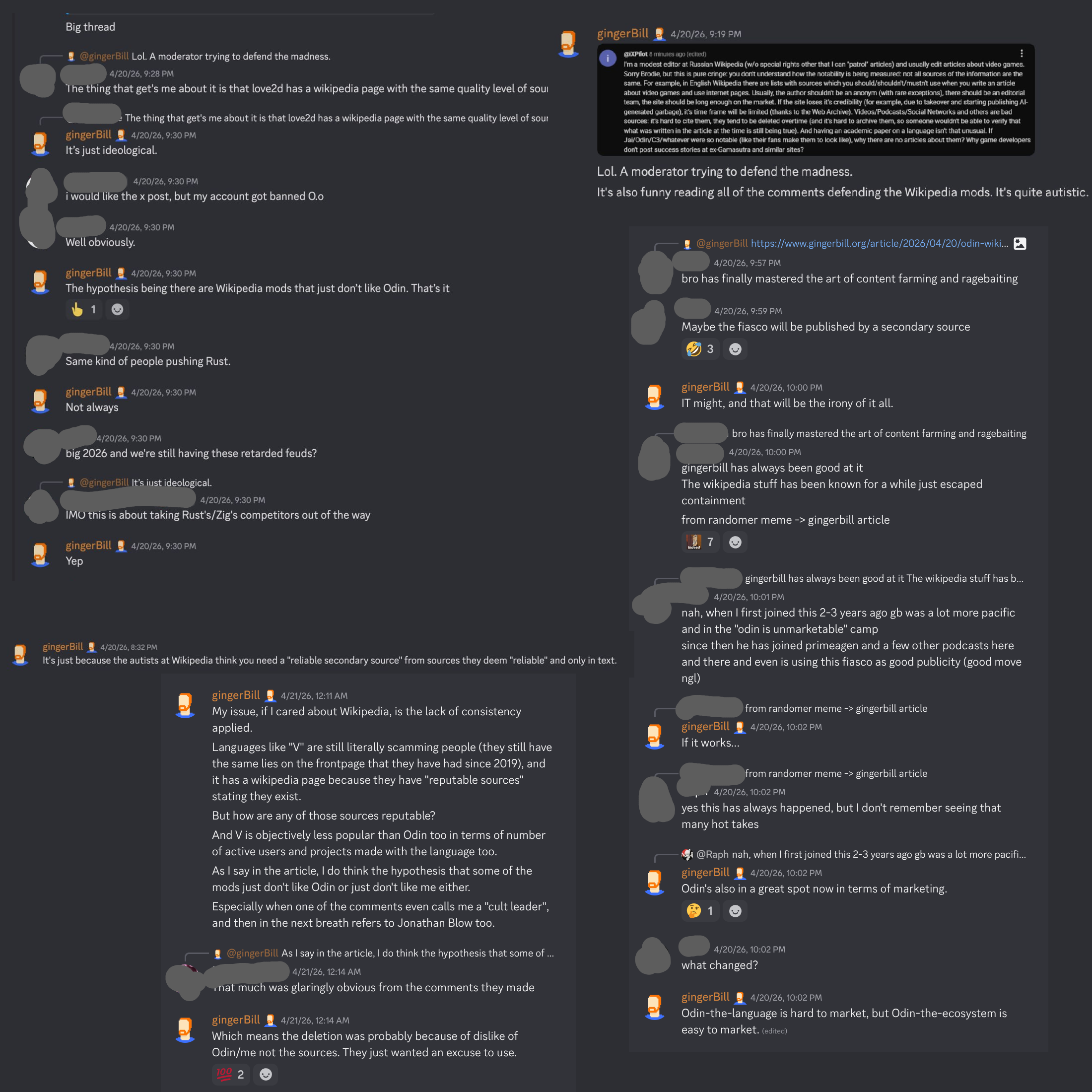
For me, seeing his tweets, it's patently obvious that GingerBill is showering in hipocrisy and contradiction. He doesn't care about Odin on Wikipedia, yet fought in several reply trenches about Wikipedia not making sense.
GingerBill's politics are quite simple: he doesn't like being challenged or having people telling him what to do. It's the mindset of a libertarian eternally stuck at 14 years old. Wikipedia is a well-made system he knows nothing about, but it has credibility which he envies. So to him the only safe engagement is to never truly engage with Wikipedia, just spread disinformation and question it while trying to underhand without doing any homework.
##Why do I even care?
I can try to reason out something, there are a lot of related statements that are true:
- I care about good software
- I'm close to Handmade community
- I care about Wikipedia
- I saw GingerBill's tweet and had a gut feeling he has a bone to pick with Wikipedia
- I was nerd sniped
- I just dislike spineless people
Well, the truth is that I have gotten off the phone with George Soros and we are cancelling Odin this time.
Truth is, most of this behavior isn't new and I just didn't care that much nor had it in my radar.
More recently, I have seen the Casey clique leaking out of their bubble more and more, generally through Łukasz / Wookash and ThePrimeagen, and I would rather push back on this reactionary culture where quality is just means for snowflakes to feel special and punch down those who don't adhere to their hierarchy. I care about quality because I care about people, not because I have some unresolved self-worth issues and a myopic vision of the world.
That behavior is pretty endemic in the Casey clique, I didn't choose GingerBill for any special reason. It just happens that GingerBill was an ass in public around the time I was finishing my blog.
Writing this has been exhausting, being a bullshitter who muddies the water on Twitter is a lot easier than being constructive, and I would like leave on a more constructive note.
Here is someone who helps build a better world rather than worsen the current one to feel better for an evening. Molly White has written an article about Elon Musk's war on Wikipedia and I highly recommend reading it: https://www.citationneeded.news/elon-musk-and-the-rights-war-on-wikipedia/
What Nawfal, Raichik, and Musk either failed to understand or deliberately misrepresented was thatthese budget categories they’ve dismissed as “DEI” directly support Wikipedia’s reliability.The funding goes to programs to expand coverage of underrepresented topics, recruit editors with expertise in neglected subject areas, develop tools to identify and counter coordinated disinformation campaigns, improve article and source reliability, and protect the project and its editors from attempts to censor or restrict access to Wikipedia content.Far from detracting from Wikipedia’s mission, these programs work to directly address the types of concerns Musk and others raise.
The name is... irony.